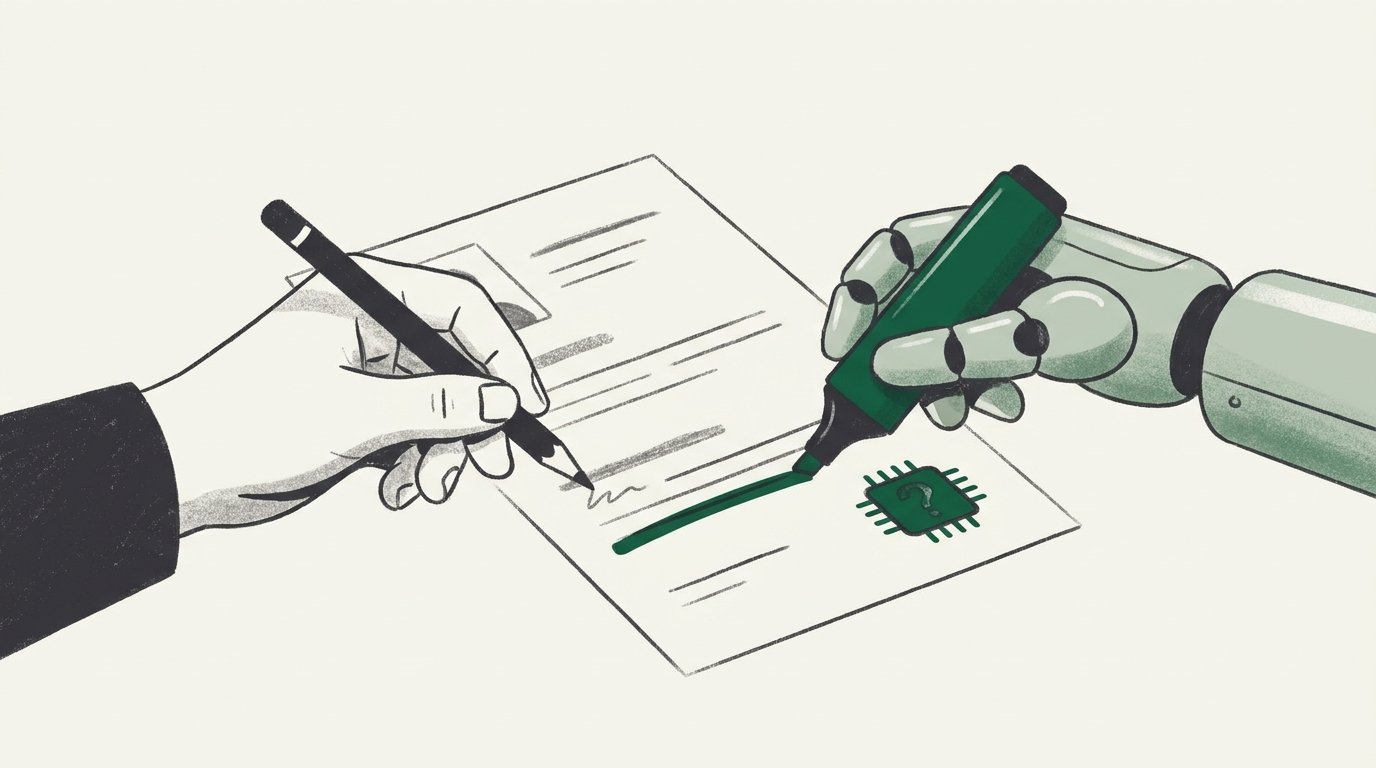
The most common ai resume mistakes are not really AI mistakes at all — they are review mistakes. A language model drafts something plausible, a tired job seeker accepts it wholesale, and the result carries fingerprints that recruiters, who now read AI-assisted applications all day, have learned to spot in seconds. None of these fingerprints are about detection software; every one of them is visible to an ordinary human reading with ordinary attention. That is the good news, because it means every one of them is also fixable by an ordinary human reading with ordinary attention: you, before you hit submit.
Here are the ten that come up constantly, roughly ordered from most damaging to most cosmetic, with the fix for each.
Mistakes 1–3: invented metrics, borrowed skills, wrong-industry jargon
1. Invented metrics. The flagship failure. You gave the model a vague bullet; it returned "increased efficiency by 40%," and the number looked so professional you kept it. Models produce metrics because resume-shaped text contains metrics — the figure has no relationship to your work. This is the most damaging mistake on the list because it converts an underwritten resume into a dishonest one, and because it detonates on a delay: the claim survives screening and dies in the interview when someone asks how you measured it.
Fix: every number on your resume must trace to something you can point at — a dashboard, a review, a defensible estimate you can explain. If AI added a figure, replace it with a real one or with honest language ("cut typical turnaround from days to hours"). The honest quantification method covers estimating without lying.
2. Borrowed skills. Prompted with a job title, models append the skills people with that title usually have. Suddenly you are proficient in two tools you have never opened, because statistically your peers are. Skills sections are interview ammunition; every listed item is an invitation to be questioned about it.
Fix: audit the skills section against a simple bar — could you use this tool or perform this skill tomorrow morning in front of someone? Delete everything below the bar.
3. Wrong-industry jargon. The model pattern-matched your title into an adjacent field's vocabulary: enterprise-software language on a nonprofit resume, agency terminology for an in-house role, American corporate idiom for a market that does not use it. To an insider reader, one wrong term is louder than ten right ones.
Fix: read your resume asking "do people in my actual field say this?" When unsure, check the vocabulary against real postings in your target niche.
Mistakes 4–6: uniform rhythm, buzzword density, the em-dash tell
4. Uniform bullet rhythm. Generated bullets tend to arrive at the same length with the same cadence — verb, object, modifier, outcome clause, roughly eighteen words, every single time. Individually each bullet is fine; stacked, they produce a metronome effect human writing rarely has, and the sameness registers before a single word is read.
Fix: deliberately vary. Cut two bullets to under ten words. Let one run longer because its content earns it. Lead one with the result instead of the verb.
5. Buzzword density. "Spearheaded cross-functional initiatives, leveraging synergies to drive impactful, scalable outcomes." Models did not invent this dialect — they learned it from decades of human resumes — but they deploy it at concentrations no human would. Each buzzword is a claim without evidence, and a paragraph of them is a paragraph that says nothing.
Fix: the swap pattern from buzzwords worth banning — replace each adjective-shaped claim with a verb and a fact. "Spearheaded" becomes what you actually did: proposed it, got it funded, ran the team, shipped it.
6. The em-dash and formatting tells. A cluster of cosmetic patterns has acquired a folk reputation as AI signatures: heavy em-dash use, "not just X, but Y" constructions, triads of parallel phrases, bolded lead-ins on every bullet. Honesty requires saying this plainly: none of these prove anything — humans have used all of them forever, and plenty of careful writers love an em-dash. The problem is correlation and concentration; when several appear densely alongside mistakes 4 and 5, readers' pattern-matching fires.
Fix: do not purge any punctuation mark out of fear. Just break up mechanical repetition of any single construction, which is good editing advice independent of AI entirely.
Mistakes 7–8: summary mismatch and unverifiable claims
7. The summary-resume mismatch. A generated summary describes a slightly different person than the resume below it — "seasoned leader driving organizational transformation" atop three years of individual-contributor roles. It happens because the summary was generated in a separate pass, optimized for impressiveness rather than consistency with the document. Recruiters read the summary last of all or first with suspicion, and a mismatch poisons trust in everything under it.
Fix: write or regenerate the summary from the finished resume, not from aspiration, and check every summary claim against a specific line below. If the summary says "leader," a bullet must show leading.
8. Unverifiable claims. Distinct from invented metrics: these are the grand, unfalsifiable statements generation loves — "recognized as a key driver of innovation," "trusted advisor to senior stakeholders." No interview question can confirm them and none can refute them, which is exactly why they carry zero weight and mildly negative signal.
Fix: the one-question test — could an interviewer verify this by asking about it? If nothing checkable exists in the sentence, replace it with something that happened.
Mistakes 9–10: over-tailoring into dishonesty, unedited placeholders
9. Over-tailoring into dishonesty. Tailoring is good practice right up until the AI rewrites your experience to mirror the posting rather than your past — retitling roles to match the target job, promoting your involvement from contributor to owner, converting exposure into expertise. Six aggressive tailorings later, six resumes describe six different people, and a reference check unravels all of them.
Fix: the rule from the tailoring workflow — tailoring changes emphasis, order, and vocabulary; it never changes facts. Any tailored line must remain a true statement about the same career.
10. Unedited placeholders and template ghosts. The unforced error: "[Company Name]" still in a bullet, "As an AI language model" fragments, a stray "[insert metric]", or another company's name surviving from the last tailored version. It says one thing — nobody read this before sending it — and for a document whose entire job is representing your attention to detail, that is a complete verdict.
Fix: mistake ten cannot survive a single slow read-through. Which is the point of the next section.
The audit pass: catching all ten in your own resume
Run this in fifteen minutes, in order:
- Claims sweep (mistakes 1, 2, 8): list every number, tool, and scope word. Source each or fix it. The claim-extractor prompt in the prompt library automates the listing.
- Insider read (mistake 3): one pass purely for vocabulary your field would find off.
- Rhythm scan (mistakes 4–6): look at the page from arm's length; fix visual monotony, then read for repeated constructions.
- Consistency check (mistakes 7, 9): summary against body; every tailored version against your master facts.
- Slow proofread aloud (mistake 10 and everything else): reading aloud is the single highest-yield edit — it catches placeholders, robotic tone, and the phrases you would never say, all at once. It anchors the full voice pass for a reason.
Why these happen: how generation actually goes wrong
The ten mistakes share one root. A language model completes patterns from its training data; it does not know your career. Given thin input, it fills the gap with what resumes statistically contain — metrics, skills, buzzwords, grandeur. Given no review step, those fillings ship. Every mistake above is the shadow of a missing input or a skipped review, which is why the evidence-first workflow prevents the whole list at once: real facts in, every change audited, voice restored at the end. And it is why recruiters, as they will tell you themselves, spot generic rather than AI — the tells are all symptoms of ungrounded generation, not of the tool.
The redline fix: reviewing AI edits one change at a time
The mistakes on this list slip through when AI output replaces your text invisibly — a wall of fluent prose is exactly the format humans rubber-stamp. The structural fix is reviewing changes as changes. In Workplacea, every AI suggestion renders as a redline diff against your original: the added metric is visibly an addition, the upgraded verb is visibly an upgrade, and each edit is accepted or rejected individually. When a stronger bullet needs a number you never provided, the editor asks you for it — the invented-metric mistake is designed out rather than caught late. You can approximate the discipline in any chat tool by demanding before-and-after output, but the principle is the same either way: never accept an edit you have not actually seen.
Frequently asked questions
Do these mistakes mean I should avoid AI for my resume?
No — they mean you should avoid unreviewed AI. Every mistake here is caught by the fifteen-minute audit pass, and AI used on real evidence with review typically produces a more specific resume than most people write alone.
Which mistake matters most?
Invented metrics and borrowed skills, without question. Style mistakes cost you polish; truth mistakes cost you the offer at interview or reference stage, after you have invested weeks in the process.
Are em dashes really an AI giveaway?
No single punctuation mark proves anything, and detection folklore changes faster than writing habits. Dense repetition of any construction reads as unedited text, whoever produced it. Edit for variety and forget the folklore.
Can recruiters actually tell, or is this all paranoia?
They reliably notice the symptoms — genericness, uniformity, claims that wobble under questions — and rarely care about the tool itself. The full picture of what they notice and what they ignore is in what recruiters told us.
Audit yours before someone else does
The fastest start is mechanical: run your resume through Workplacea's free resume checker to see how it parses and where the rubric flags weakness. Then bring it into the editor, where every AI suggestion arrives as a visible diff — the ten mistakes above are much harder to make when you can see every change before it lands.