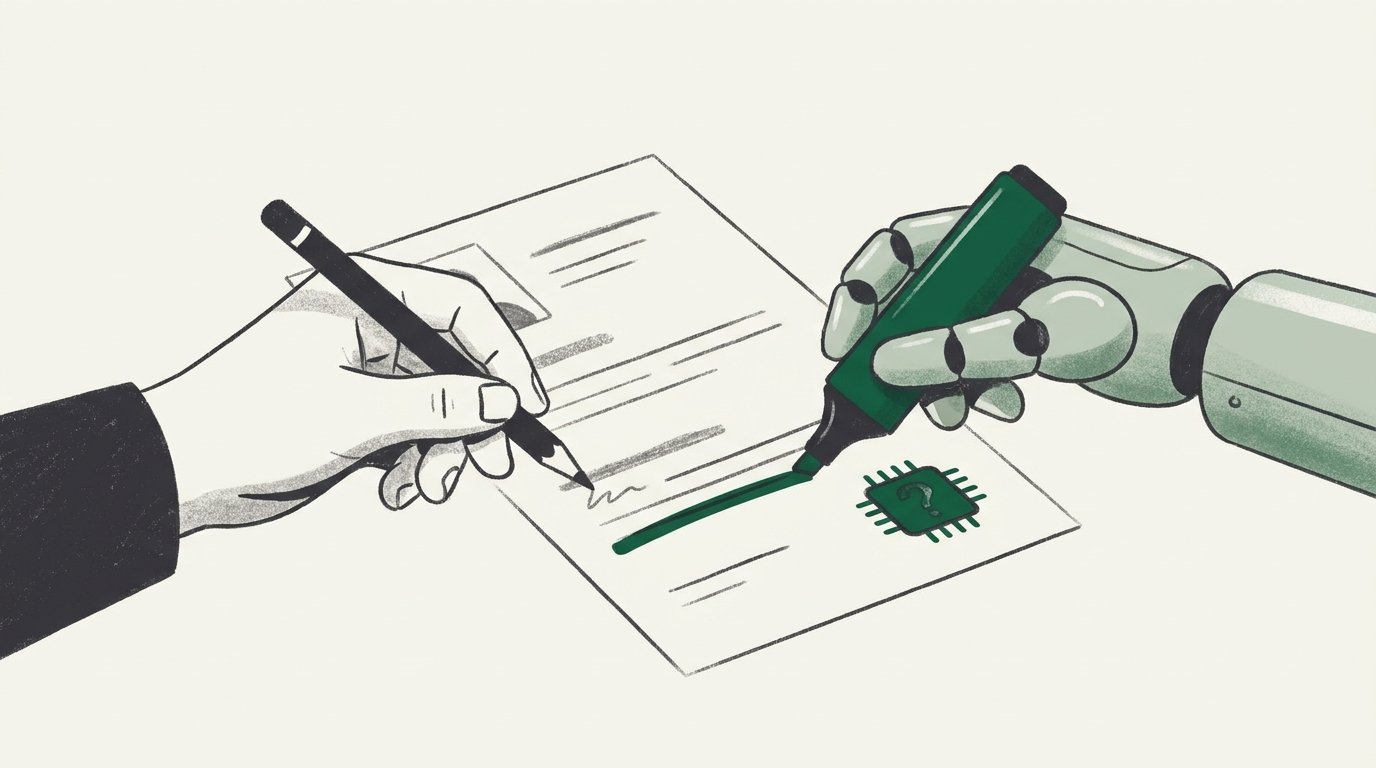
Most advice on how to use AI to write a resume gets the job description wrong. AI is not a ghostwriter you hand your career to; it is a drafting partner that works with the evidence you give it. Treat it as the first, and it will invent metrics, borrow skills you do not have, and smooth your career into the same beige paragraph everyone else is submitting this week. Treat it as the second, and it becomes the fastest editor you have ever worked with — one that never gets tired of rewriting a bullet until the claim is sharp, specific, and true.
This guide walks through the full workflow: what to collect before you prompt anything, how to draft with AI one role at a time, and the two passes — truth and voice — that separate a resume AI helped you write from a resume AI wrote instead of you.
The honest framing: AI is a drafting partner, not a biography generator
A language model has no idea what you did at work. It has a statistical sense of what people in your job title tend to write on resumes, which is precisely the problem: prompt it with nothing but a title, and it produces the average resume for that title. Averages do not get interviews.
What AI is genuinely good at:
- Compressing a rambling description of your work into a tight bullet
- Suggesting stronger verbs and cutting filler
- Restructuring information so the result leads the sentence
- Spotting vagueness ("supported the team") and asking what you actually did
- Mirroring a job posting's language across your existing, true experience
What AI is genuinely bad at:
- Knowing which of your achievements matter
- Producing numbers (it will happily supply plausible fake ones)
- Sounding like a specific human being
The workflow below plays to the first list and defends against the second.
Step 1: the evidence dump — what to give AI before any prompt
Before you open a chat window, spend twenty minutes writing down, in plain and even ugly language, what you actually did in each role. Do not format it. Do not polish it. You are building the raw material that keeps AI grounded.
For each job, capture:
- What you were responsible for — the systems, accounts, patients, projects, or people you owned
- Numbers you can defend — team size, budget, volume per week, before-and-after figures, even honest ranges ("roughly 40 tickets a day")
- Two or three specific stories — a problem, what you did, what changed
- Tools and methods — only ones you genuinely used
If you cannot remember numbers, check old performance reviews, dashboards, emails, and calendar history before you estimate. Where you must estimate, mark it as an estimate in your notes so you never accidentally launder a guess into a hard figure. The guide to quantifying achievements honestly has a full method for this.
This evidence dump is the single highest-leverage step in the entire process. Every failure mode of AI resume writing — invented metrics, generic bullets, borrowed skills — traces back to prompting with too little real input.
Step 2: drafting bullets with AI, one role at a time
Resist the urge to paste your whole career and ask for a resume. Work one role at a time, so you can inspect every output while the source material is fresh in your mind.
A prompt structure that works:
You are helping me write resume bullets. Use ONLY the facts below. Do not add numbers, tools, or achievements I have not stated. If a bullet would be stronger with a metric I haven't provided, insert [METRIC?] instead of inventing one.
Role: Customer support specialist, 2022–2024, SaaS company, team of 6. Facts: handled billing and technical tickets, about 35–45 per day; wrote 12 help-center articles; trained 2 new hires; my CSAT was consistently above team average per quarterly reviews.
Write 4 bullets, strongest first, each starting with a past-tense verb.
Two things in that prompt do the heavy lifting. The "use only the facts below" instruction constrains generation, and the [METRIC?] convention converts the model's urge to fabricate into a to-do list for you. A model told to fill gaps will fill them with fiction; a model told to flag gaps hands you questions you can actually answer.
Here is the shape of a typical before and after:
- Your raw note: "answered billing and tech tickets, around 40 a day, kept csat above team average"
- AI draft: "Resolved 35–45 billing and technical tickets daily while maintaining customer satisfaction scores above team average across eight consecutive quarters"
- Your correction: you never said eight quarters. Cut it or verify it. "Resolved 35–45 billing and technical tickets daily, maintaining CSAT above team average in every quarterly review" — true, specific, done.
Notice the model improved compression and verb choice, and also quietly added a detail. That is the pattern you will see constantly, which is why the next step exists. For a larger library of prompts with sample outputs, see the 20 tested ChatGPT resume prompts.
Step 3: the truth pass — auditing every generated claim
After drafting, read every bullet with one question: could I defend this sentence, word by word, in an interview with someone who knows the field?
Check specifically for:
- Numbers you did not provide. Any figure not in your evidence dump gets deleted or verified — no exceptions.
- Upgraded scope. "Contributed to" becoming "led"; "helped plan" becoming "owned." Scope inflation is the subtlest fabrication and the one most likely to collapse under interview questioning.
- Borrowed skills. Models pattern-match job titles to typical skills. If a bullet mentions a tool you have never opened, cut it.
- Vague superlatives. "Significantly improved," "dramatically reduced" — if you cannot say by how much, say what changed instead.
A useful trick: paste the AI draft back into a fresh chat and ask, "List every factual claim in these bullets as a checklist." Then tick each item against your evidence. It takes five minutes and catches things your eye slides past. The rundown of AI resume mistakes recruiters actually notice is essentially a catalog of what happens when this pass gets skipped.
Step 4: the voice pass — removing AI's favorite phrases
Even a factually clean AI draft tends to sound like an AI draft: every bullet the same length, the same rhythm, the same slightly inflated register. Recruiters read hundreds of these now, and while nobody can reliably detect AI text, everyone can detect generic text.
The voice pass:
- Read every bullet aloud. Anything you would never say in a conversation gets rewritten in words you would.
- Hunt the stock phrases. "Spearheaded," "leveraged," "seamlessly," "dynamic," "results-driven," "cross-functional synergies." Replace with plainer, more specific language.
- Break the rhythm. If six bullets in a row follow verb–task–metric in fourteen words, shorten two and restructure one.
- Re-inject the details only you know. The name of the system, the constraint that made it hard, the thing that surprised you. Specificity is the one quality AI cannot supply, because it does not know your life.
There is a full 20-minute voice pass method here if you want the step-by-step version.
Where AI genuinely outperforms humans (and where it fabricates)
Being clear-eyed about this saves you from both over-trusting and under-using the tool.
AI outperforms most humans at editing speed, cutting redundancy, generating variations, and mirroring a posting's vocabulary — which is why it fits so naturally into tailoring a resume to a job description. It reliably fabricates when asked to produce metrics without data, describe achievements without input, or extend claims beyond what you stated. It also fails at judgment: it does not know that your side project matters more than your job title for this particular application. That call stays with you.
Our redline approach: seeing exactly what AI changed and why
The riskiest moment in any AI resume workflow is the invisible edit — a rewrite where you cannot see what changed, so fabrications slip through on the strength of fluent prose. This is the specific problem Workplacea was built around. Every AI suggestion in the editor appears as a redline diff: original on one side, proposed change marked up against it, accepted or rejected one change at a time. Nothing is auto-applied. And when a bullet would benefit from a number you have not provided, the editor asks you for it rather than making one up.
You can replicate a rough version of this discipline in any chat tool by asking the model to show old and new versions side by side — the prompt library includes a diff-style critique prompt. The point is not the tool; it is the principle that you should never accept a change you have not seen.
The full workflow, condensed into a 45-minute session
- Minutes 0–15: evidence dump. One role at a time, plain language, real numbers, marked estimates.
- Minutes 15–30: drafting. Grounded prompts per role,
[METRIC?]placeholders, three or four bullets each. - Minutes 30–38: truth pass. Checklist every claim against your evidence. Delete or verify anything unsourced.
- Minutes 38–45: voice pass. Read aloud, swap stock phrases, vary rhythm, add specifics.
If you are choosing a dedicated tool rather than a chat window, the comparison of AI resume builders covers how the major products handle — or fail to handle — the grounding problem.
Frequently asked questions
Will using AI make my resume look like everyone else's?
Only if you use it the way everyone else does: minimal input, maximal generation. The evidence-first workflow produces output grounded in your specific history, which by definition cannot match anyone else's. The generic-resume problem is an input problem, not an AI problem.
Can employers tell my resume was written with AI?
Not reliably. Detection tools are unreliable on short, structured text like resumes, and recruiter practices vary widely. What recruiters do notice is generic phrasing, uniform structure, and claims that do not survive interview questions. Solve those and the provenance question mostly evaporates — the recruiter perspective piece goes deeper.
Should I let AI write my whole resume from a job title?
No. Output generated from a title alone is a statistical average of other people's resumes. It will read as plausible and say nothing true about you. Always draft from your own evidence.
Is it dishonest to use AI on a resume?
Using AI to phrase true things well is editing, and nobody discloses their editor. Using AI to generate claims that are not true is lying, with or without AI. The line runs through the claims, not the tool.
Draft with AI, decide for yourself
Workplacea is built for exactly this workflow: AI suggestions shown as visible diffs, guardrails that ask for missing metrics instead of inventing them, and nothing applied without your approval. Run your current resume through the free resume checker to see what a parser and a published rubric make of it, or start drafting in the editor. The checker, editor, and AI tools are included; the free plan also gives you three core templates and your first clean, watermark-free PDF. Paid plans add premium designs and unlimited clean exports, with no resume or variant count cap hiding in either plan.