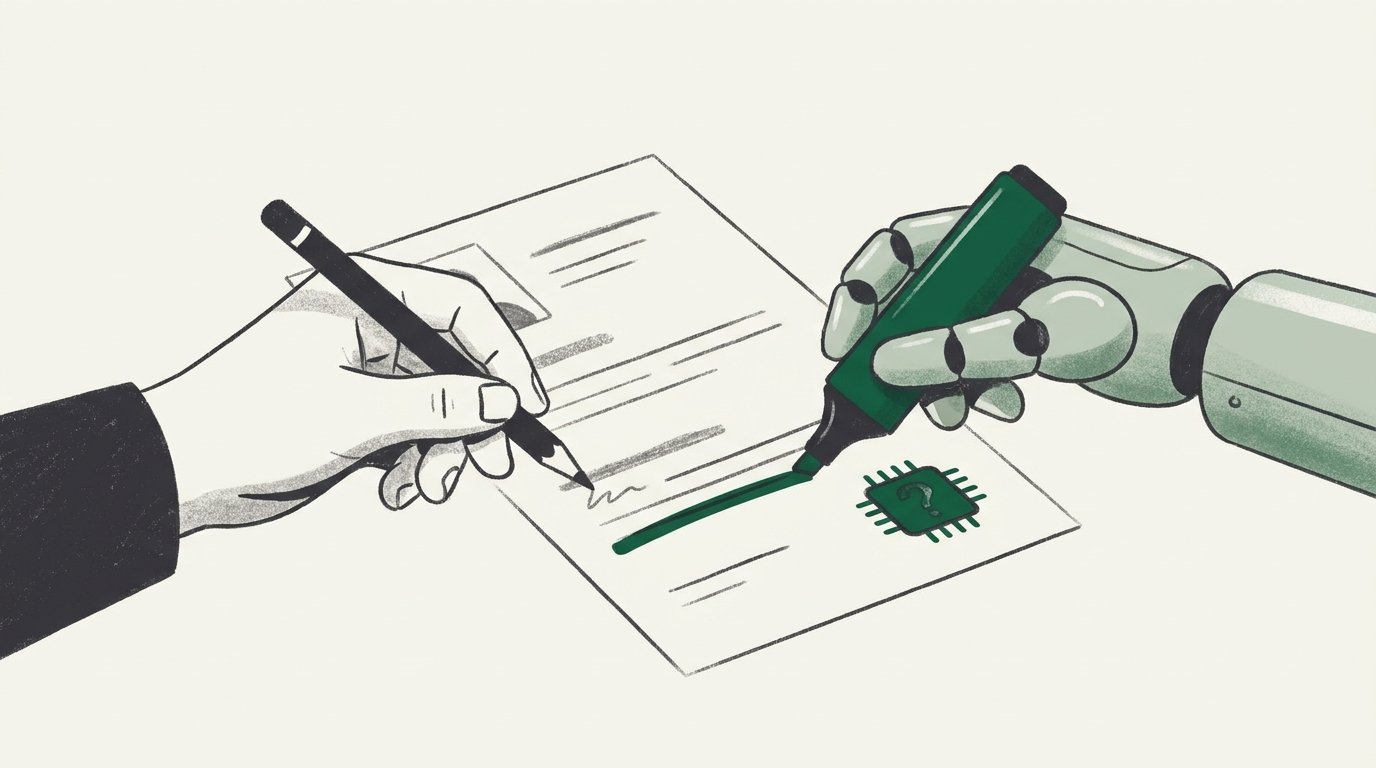
Here is an underrated fact about feedback: almost nobody in your life will tell you your resume is boring. Your friends are kind, your family is impressed by you on principle, and even professional reviewers soften the blow because you are the customer. An ai resume review flips this dynamic completely — a language model has no relationship with you to protect, which makes it the one reviewer you can explicitly instruct to be merciless and that will actually comply. Used well, this is the cheapest high-quality critique available anywhere. Used naively, it produces either flattery or confident noise. This guide is about the difference.
One scope note up front: AI review is a different activity from AI writing. Writing with AI risks fabrication and needs grounding discipline. Review is safer — the model only critiques what already exists — but it has its own failure modes, and its own blind spots, both covered below.
Why AI reviews beat asking friends: no politeness filter
Human feedback on resumes fails in predictable ways. People close to you evaluate the person, not the document — they know what you meant, so they cannot see what you failed to say. Strangers give you generic rules from decade-old advice. And nearly everyone defaults to "looks good, maybe tweak the font," because specific criticism costs social effort.
A model has none of these constraints, plus two structural advantages: it has read enormous amounts of resume-shaped text, so it recognizes cliché and vagueness instantly, and it never fatigues — you can ask for the twelfth pass on one bullet with the same quality as the first.
But there is a catch that shapes everything else in this guide: by default, chat models are trained toward helpfulness and agreeableness, which in review contexts drifts into flattery. Ask "what do you think of my resume?" and you will get compliments with light suggestions. The fix is calibration — you must build the harshness into the prompt.
The brutal-critique prompt, calibrated to not flatter you
This is the base prompt. Paste your resume text after it.
You are reviewing my resume. Your instructions:
- You are a skeptical senior recruiter screening 200 applications for [target role]. You are looking for reasons to reject, because that is what screening is.
- Do not compliment me. Do not soften. If something is fine, say nothing about it.
- For every weak line, tell me: why it fails, what question it leaves unanswered, and what information would fix it. Do not rewrite it for me — ask me for the missing information instead.
- Rank your criticisms by how much each one costs me.
- End with the single change that would most improve this resume.
Three design choices worth understanding. "Looking for reasons to reject" matches how screening actually works and produces sharper reading than "give feedback." "Ask me for the missing information" keeps the review from sliding into generation — the model identifying that a bullet needs a number is valuable; the model inventing that number is the failure mode this whole cluster warns about. And ranking forces prioritization, because an unranked list of twenty nitpicks is procrastination fuel.
Expect the output to sting slightly. That is the signal it worked.
Role-play reviews: AI as the hiring manager for this posting
The generic critique above improves the document; the role-play review improves the fit. Give the model the actual posting:
You are the hiring manager who wrote this job posting. You have my resume in front of you. [paste posting]
- What would make you shortlist me, in one sentence?
- What are your three biggest hesitations?
- Which requirement do you see no evidence for?
- What would you ask me first in a screen — and what does that question tell me is unclear on paper?
Question 4 is the quietly powerful one: a hiring manager's first question is almost always aimed at the biggest gap between what they need and what your resume shows. Running this review per application takes five minutes and pairs naturally with the 15-minute tailoring workflow — the review tells you what to fix, tailoring fixes it.
Two more reviewer personas worth rotating in: the skeptic in your field ("you are a senior [profession]; which claims here would make you roll your eyes?") catches insider-credibility problems, and the confused outsider ("you know nothing about my industry; list every line you cannot understand") catches jargon before a non-specialist recruiter does.
Interpreting automated scores skeptically — including ours
Chat critiques are one branch of AI review; scored checkers are the other. Upload a file, get a number. The essential skill is knowing what a score is: a measurement of proxies. A checker can genuinely measure structural facts — whether your file parses cleanly, whether sections are detectable, whether bullets contain quantification, whether keywords from a posting appear. It cannot measure whether your claims are true, impressive for your field, or well-targeted to an actual human's priorities. A resume of confident fabrications can score beautifully.
So treat any score — very much including ours — as a checklist compressed into a number, useful for finding mechanical problems and tracking whether edits helped, meaningless as a verdict on your candidacy. Be extra skeptical of tools that gate the explanation behind a paywall: a number you cannot inspect is marketing, not measurement. That belief is why Workplacea's rubric is published in full — every check, every weight, explained line by line — and why our free checker shows you the raw parse alongside the score, so you can see exactly what the machine saw rather than trusting a grade.
What AI review misses: taste, industry nuance, truth-checking
An honest guide has to mark the blind spots, because they are real:
- Truth. The model cannot know your numbers are invented or your title is inflated. A fabricated resume reviews well; only you and eventually an interviewer can audit truth. Review passes never replace the truth pass.
- Current industry nuance. Models can lag or overgeneralize on what your specific field values this year. A model may push quantification onto a research CV where it reads oddly, or miss norms of your niche entirely.
- Taste and judgment. Which of your achievements matters most for this stage of your career is a judgment call. The model weighs everything by plausibility, not by knowledge of your goals.
- The human moment. No AI predicts what a particular hiring manager will connect with. Sometimes the odd detail a model flags as irrelevant is what starts the interview conversation.
The practical implication: use AI review to eliminate the known catalog of resume mistakes and sharpen weak lines, then get one human in your target field to spend ten minutes on the result. The AI raises the floor; the human calibrates the ceiling.
The review-revise loop: three rounds to a stronger resume
The full method, as a repeatable session:
Round one — structural (15 minutes). Run the brutal-critique prompt. Fix only the top three ranked problems, supplying real information where the review asked for it. Resist fixing everything; the long tail of nitpicks can wait.
Round two — targeted (10 minutes). Fresh chat, role-play review against your target posting. Adjust emphasis, ordering, and terminology for the gaps it exposes. A fresh chat matters — a model that just watched you edit will grade its own suggestions kindly.
Round three — line-level (10 minutes). Fresh chat again. Paste the revised resume and run the vagueness detector from the prompt library: every phrase that could appear on a stranger's resume, listed. Rewrite what you can with specifics; delete what you cannot.
Then stop. Rounds four onward produce oscillation, not improvement — the model will happily un-suggest its own earlier suggestions forever. Finish with the two checks no chat review provides: a parser check on the actual file, and your own read-aloud pass for voice.
Frequently asked questions
Is an AI resume review accurate?
It is reliably good at detecting vagueness, cliché, structural problems, and missing evidence — pattern-level weaknesses. It is unreliable on field-specific norms and incapable of verifying truth. Trust it as a tireless line editor, not as an oracle on your career.
Why did the AI give me completely different feedback the second time?
Some variance is inherent to how models generate text, and it grows when prompts are vague. Calibrated prompts with a specific persona and ranking instruction produce much more stable reviews. Where two runs disagree, the overlap between them is usually the real signal.
Should I pay for an AI resume review service?
Rarely. The chat prompts here are free, and scored checkers worth using have free tiers — ours included. Paid review earns its fee mainly when it comes with an actual human expert attached, which is a different product.
Can AI review my resume against multiple jobs at once?
Yes — run the role-play review per posting in separate chats, then compare the hesitations lists. Recurring hesitations across postings are resume problems; one-off hesitations are targeting problems. That distinction tells you whether to revise the master document or the tailored version.
Get the merciless version of the truth
Two free minutes gets you the mechanical half of a review: upload your resume to Workplacea's free resume checker for the raw parse and a score against a published rubric — no account, no email capture. When the critique turns into edits, the editor shows every AI suggestion as a diff you approve, so revision never drifts into fiction.