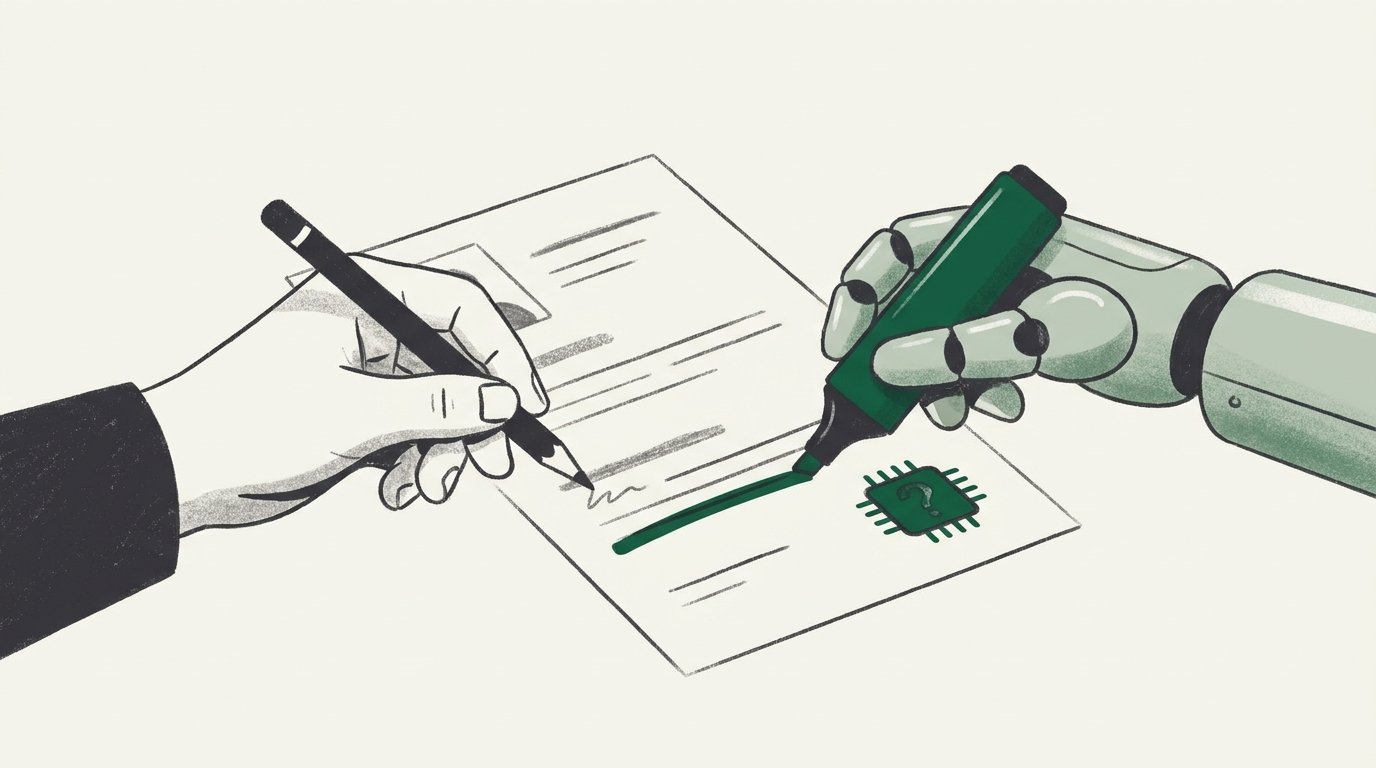
Ask for a ChatGPT cover letter with nothing but a job title and a company name, and you will get the letter every hiring manager now recognizes on sight: "I was excited to discover this opportunity," a paragraph of enthusiasm about a company the model knows nothing about, three claims of passion unsupported by a single specific event, and a confident closing about being a perfect fit. It is grammatical, warm, and completely hollow — because the model was given nothing to say and said it beautifully.
Cover letters are actually the place where generic AI output costs you most. A resume is a structured document; sameness there is partly forgivable. A cover letter exists for exactly one reason — to say something your resume cannot — so a generic one does not merely fail to help. It advertises that you had nothing to add. The fix is the same input-first principle as resume prompting, with one extra ingredient: a story.
Why AI cover letters all sound the same — and the input fix
Language models generate the most statistically likely text for a request. Thousands of cover letters share the same skeleton, so a low-input request returns that skeleton. The model cannot know why you specifically want this job or what you specifically did that proves you can do it. Those two facts are the entire value of a cover letter, and they only exist in your head.
The fix is not a cleverer instruction. It is refusing to let the model draft until you have given it three things:
- One true story from your work that is relevant to this job
- One honest, specific reason this role or company interests you
- The posting itself
No prompt below works without these. That is a feature.
The context template: your story, their posting, one honest angle
Fill this in before any drafting prompt. Rough language is fine — better than fine, since your phrasing is what keeps the letter yours.
CONTEXT — use only what is written here; do not add claims, and do not manufacture enthusiasm:
THE STORY: [4–6 sentences on one relevant thing you did. What was the situation, what did you do, what changed. Include real numbers only if you can defend them.]
THE ANGLE: [1–3 sentences on why this role, honestly. "Your job post mentions owning the reporting pipeline end to end, and that is the part of my current job I most want to do full time" beats any manufactured passion.]
THE POSTING: [paste it]
MY RESUME HEADLINE FACTS: [title, years, 2–3 top proof points — so the letter can reference without repeating the resume]
If you cannot fill in THE ANGLE truthfully, that is worth knowing before you apply. A letter cannot fake what you cannot state.
The drafting prompt sequence, with the outputs to expect
Prompt 1 — structure before prose:
From my context, outline a 4-paragraph cover letter: (1) a specific opening that names the role and my angle, no "I am excited to apply"; (2) the story, compressed; (3) how that maps to their posting's stated needs; (4) a plain closing. Outline only, no prose yet.
Reviewing an outline takes thirty seconds and catches structural padding before it becomes paragraphs.
Prompt 2 — the constrained draft:
Write the letter from that outline. Under 300 words. Rules: no exclamation marks, no "passionate," "thrilled," or "perfect fit," no claims absent from my context, and every sentence must contain information — cut anything that only expresses attitude.
Prompt 3 — the alternative opening:
Give me 3 different first sentences: one leading with the story, one leading with the angle, one leading with a fact about my experience that matches their top requirement.
Openings are where sameness concentrates. Here is the shape of the difference:
- Generated default: "I am writing to express my strong interest in the Operations Coordinator position at Meridian Health."
- Story-led: "Last spring I inherited a scheduling backlog of 300 appointments and cleared it in three weeks; your posting reads like a description of that month."
The second is only possible because the story existed in the context. The full four-paragraph architecture, if you want to draft with more manual control, is covered in how to write a cover letter.
Revision prompts: shortening, sharpening, de-fluffing
The cut pass:
Cut this letter by 25% by deleting sentences that contain no information a hiring manager could act on. Show me what you cut, as a list.
Asking for the deletions as a list matters — you review the cuts rather than diffing paragraphs by eye.
The evidence audit:
List every claim in this letter. Mark each as: stated in my context, implied by my context, or added. I will remove everything in the third category.
The same anti-hallucination discipline as resume work, because generation adds material in letters even more freely — narrative text gives it more room to be plausible.
The specificity pass:
Flag every sentence that could appear in a letter for a different company without edits. Suggest what specific detail from the posting or my context could replace it.
The repetition check:
Does any sentence in this letter restate a bullet from my resume facts nearly verbatim? Flag them — the letter should add context, not repeat the resume.
The AI-smell edit: phrases to hunt down and replace
Certain phrases now function as fingerprints of low-effort generation — not proof AI was used (people wrote clichés long before models did), but a signal that nobody edited. Hunt these:
- "I am excited to apply for" / "thrilled at the opportunity"
- "perfect fit" and "ideal candidate"
- "leverage my skills" and "utilize my experience"
- "fast-paced environment," "dynamic team," "proven track record"
- "aligns perfectly with my passion"
- Any sentence about the company copied from its own About page
Replace each with something only you could write: the specific feature of the job you want, the specific result you got, the specific reason the company crossed your radar. Then read the letter aloud once. Anything you would be embarrassed to say to the hiring manager's face gets rewritten in words you would actually say — the same read-aloud test that anchors the voice pass for AI-assisted resumes.
For a broader look at when a letter is worth sending at all and how AI fits the decision, see the guide to AI cover letters.
Ethics check: what you can honestly claim AI helped you say
The standard is simple and the same one we apply across AI-assisted resume writing: AI may improve how you say true things; it may not supply the things. A letter drafted by AI from your real story, checked claim by claim, and edited into your voice is your letter — you chose every fact and approved every sentence. A letter generated from a job title, containing enthusiasm you do not feel and experience you do not have, is a misrepresentation regardless of what tool typed it.
Two edge cases worth naming. First, company flattery: do not let the model praise a mission you have not read about — either find a real reason or write a letter that stands on your evidence alone. Second, borrowed anecdotes: models occasionally embellish your story with dramatic details that did not happen. The evidence audit prompt exists precisely for this. Interviewers ask about cover letter stories more often than people expect, and an embellished detail collapses fast under a friendly "tell me more about that."
Frequently asked questions
Should I even send a cover letter if it is optional?
When it is optional, a specific letter helps and a generic one mildly hurts, so the real question is whether you have something specific to say. If you can fill in the story and the angle from the context template, write it. If you cannot, your time is better spent tailoring the resume.
Can hiring managers tell my cover letter came from ChatGPT?
They can tell when a letter is generic, and unedited AI output is reliably generic. Detection tools are unreliable and practices vary, so the practical risk is not being caught — it is being skimmed and forgotten. A letter grounded in a real story does not have this problem, whatever drafted it.
How long should an AI-assisted cover letter be?
Under 300 words is a good constraint to give the model, and under 250 is often better. Brevity forces the story and the angle to carry the letter, which is exactly the material generation cannot fake.
Should the letter mention that I used AI?
No one expects disclosure of drafting tools, any more than they expect you to credit spellcheck or a friend who proofread. The obligation is that every claim is true and every word is one you stand behind — not that you wrote alone.
Say it in your own words, faster
Workplacea applies the same grounding to letters as to resumes: drafts built from your evidence, every AI change shown as a diff you approve or reject, nothing invented on your behalf. Try the workflow in the editor — and if your resume is doing the applying alongside the letter, give it two minutes in the free resume checker first.